
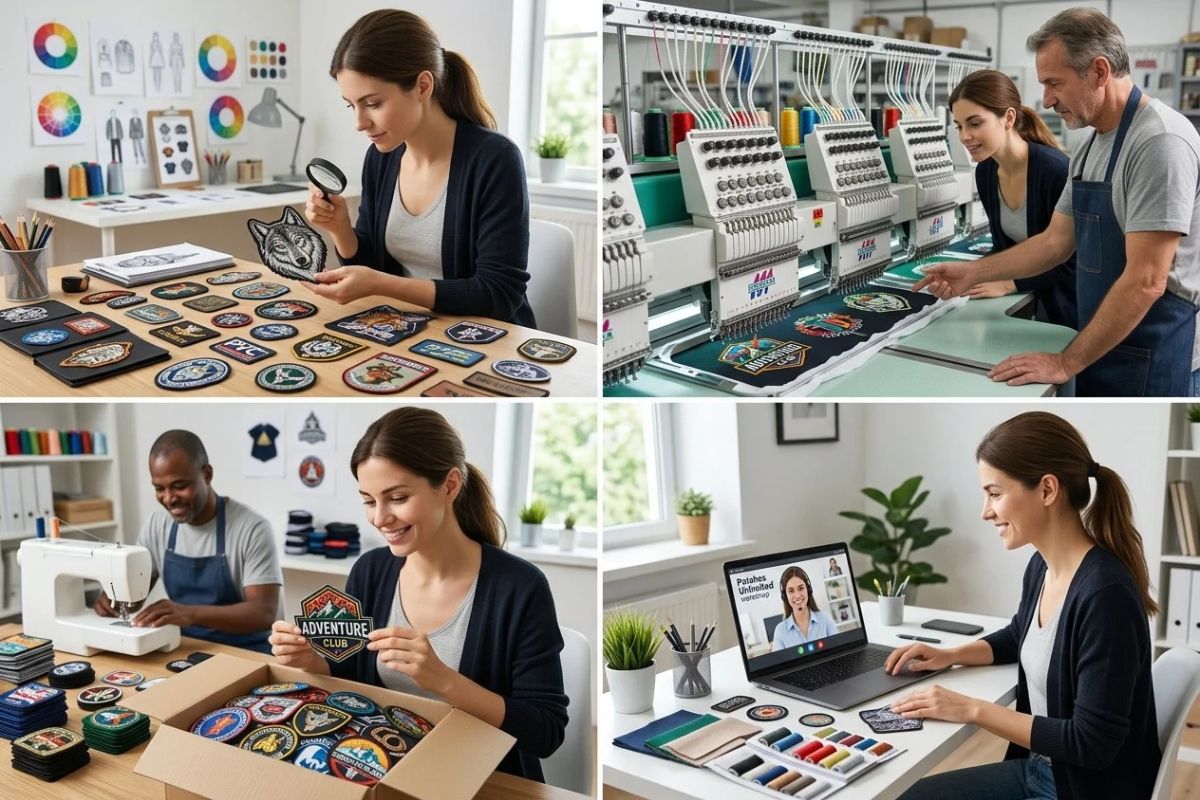
How to Pick the Professional Custom Patches Maker
Selecting a good custom patch manufacturer may seem like a tough job. You might already have a well-defined design, have a perfect idea of the colour combinations you wish to use, and even have an ideal idea of how your custom patch would look once it is manufactured.
But selecting the wrong manufacturer will give you a bad-quality finish, poor-quality colours, or even a custom patch that has nothing in common with your original design. It is quite disappointing, especially if you are placing your order for business or team purposes. Let’s explore what to look for before placing your order.
What Should You Check Before Choosing a Patch Maker?
Firstly, you need to look beyond the beautiful pictures of their products and low costs. A competent manufacturer will be able to provide you with a variety of options, answer all your questions and assist you in choosing a suitable type of patch.
These points should be considered first of all:
- Experience: Experience of working with this kind of patch is essential, especially if your design has small text and several colours.
- Products offered: Find out whether the manufacturer makes embroidered, woven, printed and rubber patches.
- Options available: Inquire about the diversity of patch shapes, sizes, backings, borders and colours.
- Contact information: A reliable manufacturer should inform you how to order patches and what information should be provided to begin their production.
- Delivery: Estimate the production time required, delivery conditions, and how the order will be dealt with in case of any damage or mistake.
By doing this, you will see if the supplier is able to cater to your needs or just accepts your order. In case you are ordering goods for your business or any occasion, make sure you receive a sample or proof of your order.
How to Evaluate the Quality of Their Work?
The patch can be aesthetically pleasing on screen, but it will be completely different once delivered to you. It could look messy, frayed at the edges or even have details that are hard to make out. This is the reason why checking the work of the maker should be one of your considerations.
Examine Samples and Previous Projects
Ask for clear photos of finished products. The close-up photos will be especially useful since they will show details that are difficult to see in regular product photos. Look out for:
- Stitching and edging: Embroidered patches should have good stitching, and the edging should be nice and finished.
- Colour accuracy: The colours will be reasonably accurate to the design that was approved, taking into account the difference in display colours vs. real life.
- Shape and positioning: Letters, logos, and other elements should all be placed properly and not stretched or crooked.
If possible, request a physical sample before placing a large order. A sample gives you a better idea of the actual texture, thickness, finish, and attachment method.
Which Patch Material Should You Choose?
Every design suits all materials. Embroidery patches will be perfect for bold logos, uniforms, jackets, and hats. Woven patches will suit you best if your design contains small text and details. In case your artwork contains photos, gradients, and other colour changes that can’t be easily embroidered, then printed patches are the best solution for you.
If you want a raised look, unique shape, and rubberised texture, then custom PVC patches will be the right choice for your needs if your patches will be attached to bags, the outside environment, and tactical gear. Think about the place where the patches will be located and the look that you would like to achieve.
Do Proofs Exist Before Manufacturing Starts?
A digital proof is one of the easiest ways to prevent mistakes before your order is produced. It demonstrates the way your design will look, in terms of form, colours, text, and general design layout.
It is a good practice for a professional maker to let you review the design and make corrections if needed. Check the proof for:
- Correct spelling and logo placement.
- Accurate dimensions and proportions.
- Colours that match your approved design as closely as possible.
- Clear text and recognisable details.
- The correct border, backing, and attachment method.
For instance, when ordering Halloween patches with small fonts, pumpkins, or even elaborate artwork, ensure that such elements appear clearly at that small size. Designing something that looks great on your large computer screen could end up not showing enough detail when reproduced in a patch.
What Should Be the Cost of Custom Patches?
Price is an important factor, especially when you order thousands of patches for your organisation or event. But it is unwise to go for the cheapest quotation without finding out what comes with it.
Generally, the prices of custom patches are affected by many factors, including:
- Size and shape: The bigger the size of the patch, the higher the cost of material/production needed.
- Quantity: In large numbers, you could be eligible for cheaper quotations depending on the supplier’s pricing system.
- Material: There are various materials used to produce patches, such as embroidery, weaving, printing and PVC moulding, among others.
- Complexity of design: If the design of the patches is intricate, this could increase the cost.
- Finishing: Finishes like hook-and-loop backings and edges, among others.
When comparing suppliers, request a cost analysis of the total price. Verify whether the artwork creation, samples, packaging, shipment, and tax costs have been included.
Can They Deliver Your Order on Time?
A great design is just one aspect of this process. If the patches arrive late after the launch of a product, a corporate event, or an ongoing season campaign, then no matter how high quality they are, they will fail to help you.
Request that the company provide you with all the information regarding their delivery process, including the time for the creation of the sample, production process, quality check, and shipping time.
Before placing your order, confirm:
- The estimated production and shipping dates.
- Whether rush production is available.
- How you will receive updates during production.
- What happens if the order is delayed.
- Whether tracking details are provided after dispatch.
Regarding seasonal items, make your purchase well in advance so as to provide sufficient time for any design alterations that may be required or any unforeseen delay in receiving your order.
What Warning Signs Should You Watch For?
Even if a supplier offers attractive prices and an impressive catalogue, certain warning signs deserve attention. Be cautious if a maker:
- Avoids showing previous work or providing samples.
- Gives vague answers about materials and production methods.
- Refuses to confirm the final design before manufacturing.
- Offers unusually low prices without explaining what is included.
- Cannot provide a clear delivery estimate or written order details.
- Has unclear payment terms or no practical process for handling faulty products.
Consider the customer reviews, if available. Consider comments related to the quality of the product, communications, delivery, and handling of complaints rather than the number of stars assigned to them.
Readers Usually Ask
How can you determine the right custom patch maker to choose from?
Compare previous samples, materials, customer ratings, costs, and delivery. Ask for a digital proof, and in case of large or complicated orders, even consider having a physical sample before giving a go signal to mass production.
Is it appropriate to use custom PVC patches outdoors?
Yes, because the patches are water-resistant and easy to clean. Therefore, customised PVC patches can be used outside. The longevity of the patches will depend on many factors.
Can you get patches in small quantities?
Some sellers sell patches in small quantities, but some have a minimum quantity per order. Remember to check the minimum quantity first before requesting an offer.
To Conclude!
Selecting the appropriate patch maker is made easier by knowing how to do so. There is no doubt about the fact that price is not the only thing that you have to think about. You have to think about the material used, any work done before, proof of the designs, communication, and delivery logistics.
The supplier must know what the customer wants and recommend the right type of finish for the patch. This will save both time and money while ensuring that one gets patches as per the expectation.

As the author of australiapatches.com.au, I provide useful information about patches, printed, embroidered, and PVC patches, as well as market trends and practical uses. With a hands-on approach and an Aussie perspective, I help readers choose quality solutions, understand materials, and navigate suppliers with confidence, clarity, and honest advice. Tailored guidance for Australian companies and artists.